When people think of power, they often imagine aggression: raised voices, ultimatums, or someone pounding a table. But that’s not real leverage. Real power is quiet. It’s intentional. It shows up in the way you frame a question, make a request, or structure an offer.
In high conflict negotiations, especially with difficult personalities, mastering negotiation means mastering your words to create leverage. Every sentence either strengthens your position or gives it away.

Language is Leverage
In negotiation, your words are both your offense and your protection. You need language that’s confident but controlled, clear but strategic. This isn’t a place for emotional release. This is about positioning yourself to prevail.
The most powerful negotiators aren’t the loudest voices in the room. They’re the ones who quietly steer the conversation while revealing nothing about how much they care. That means keeping your tone neutral and choosing words like “consider,” “evaluate,” or “propose” instead of “need,” “must,” or “have to.” It signals that you’re reasonable while still holding a firm boundary.
The way you phrase things matters. Instead of saying, “I want custody,” say, “Let’s focus on what provides the children with consistency and stability.” That shift positions you as rational, especially when the other side is acting emotionally or manipulatively.
Persuasion Isn’t Manipulation
You don’t have to out-argue someone to outmaneuver them. You just have to stay focused on what actually motivates them. In high-conflict negotiations, especially when you’re dealing with someone manipulative or narcissistic, the key is to communicate in terms they respond to.
What do they care about? Image, control, and winning. If you try to appeal to empathy, you’ll lose. But if you present an option in a way that protects their ego or lets them believe they’ve won something, you’re far more likely to get your desired outcome.
For example, if you want to negotiate with a narcissist, direct confrontation will backfire. Instead, say something like, “This option allows both of us to walk away with dignity.” That feeds their sense of importance while allowing you to exit the conversation with what you need.
The Power of Silence and Curiosity
Not every winning move needs to be verbalized. Silence is one of the most underused tools in negotiation. When you stop talking, you force the other side to fill the space. In this case, silence is leverage: they often disclose more than they intend to.
Ask short, strategic questions, then pause. “What’s your reasoning behind that offer?” or “Can you walk me through how you arrived at that?” These questions slow the conversation and shift control. They also project calm and confidence, even if your nervous system is firing underneath.
And when you do speak, use curiosity as a strategic advantage. Curiosity doesn’t signal weakness; it signals control of the conversation. Instead of reacting emotionally, you’re collecting information. That’s what skilled negotiators do to gain leverage.
Avoid These Language Traps
When the stakes are high, it’s easy to slip into language patterns that quietly undermine your position. Phrases like “I feel like,” “I just think,” or “I hope” dilute your message. They communicate uncertainty. And uncertainty erodes your leverage.
You might also feel tempted to apologize for taking up space. Don’t fall into that trap. Don’t say, “Sorry, but can I ask something?” Say, “I have a question.” You’re not a visitor in this conversation. You’re a decision-maker at the table.
Also, avoid emotional over-disclosure. Sharing too much, especially in legal or high conflict settings, hands the other side leverage. Keep your communication concise, fact-driven, and intentional. Let your words work for you without revealing your emotions.
Words That Reclaim Your Leverage and Power
If you’ve ever felt steamrolled in an argument or silenced in a negotiation, chances are your language didn’t match your inner clarity. That doesn’t mean you were wrong. It means you didn’t have the right words at the right time.
Start by replacing weak phrases with power statements. Use “Here’s what works for me” instead of “I was hoping…” Say “I’m clear on my position” rather than “I don’t know if that’s okay.” And use phrases like “That doesn’t work for me” to set boundaries without needing to justify them.
You’re not here to be liked. You’re here to be heard. Mastering persuasive influence doesn’t mean becoming someone you’re not. It means finding your voice and using it with intention.
Practice Wins the War
Every negotiation you encounter—whether it’s with a boss, a partner, or a narcissistic ex—is a chance to step into your power. You don’t need to be flawless. But you do need to be prepared.
Rehearse what you’ll say before the actual conversation happens. Write down a few key phrases that keep you grounded and confident. Anticipate attempts to destabilize you, and practice responding without becoming reactive.
You’ll notice that when you stop trying to win emotionally and start communicating with confidence, the dynamic shifts. You become the steady presence in the chaos. You shape the narrative. You create leverage with your words.
Video

Infographic
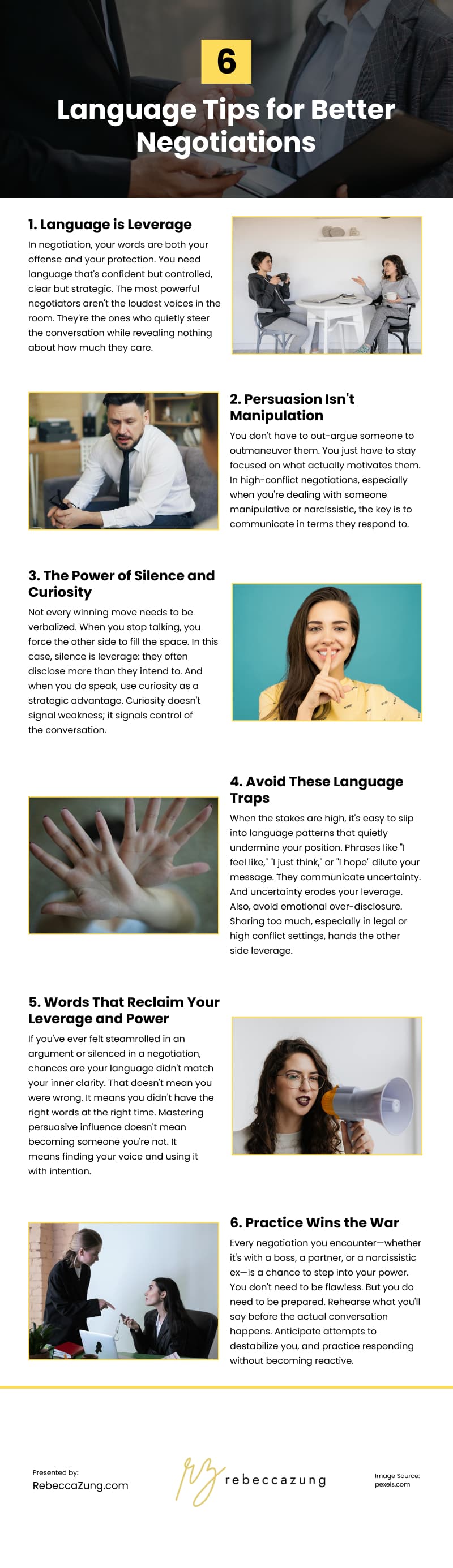
Real power in negotiation comes from quiet, deliberate communication—not aggression. In high‑stakes situations, especially when dealing with difficult personalities, choosing your words carefully becomes a key source of leverage. This infographic shares practical language techniques to strengthen your negotiation skills.